Winter Swinging on the Middle Rangitikei
… Nick Taransky
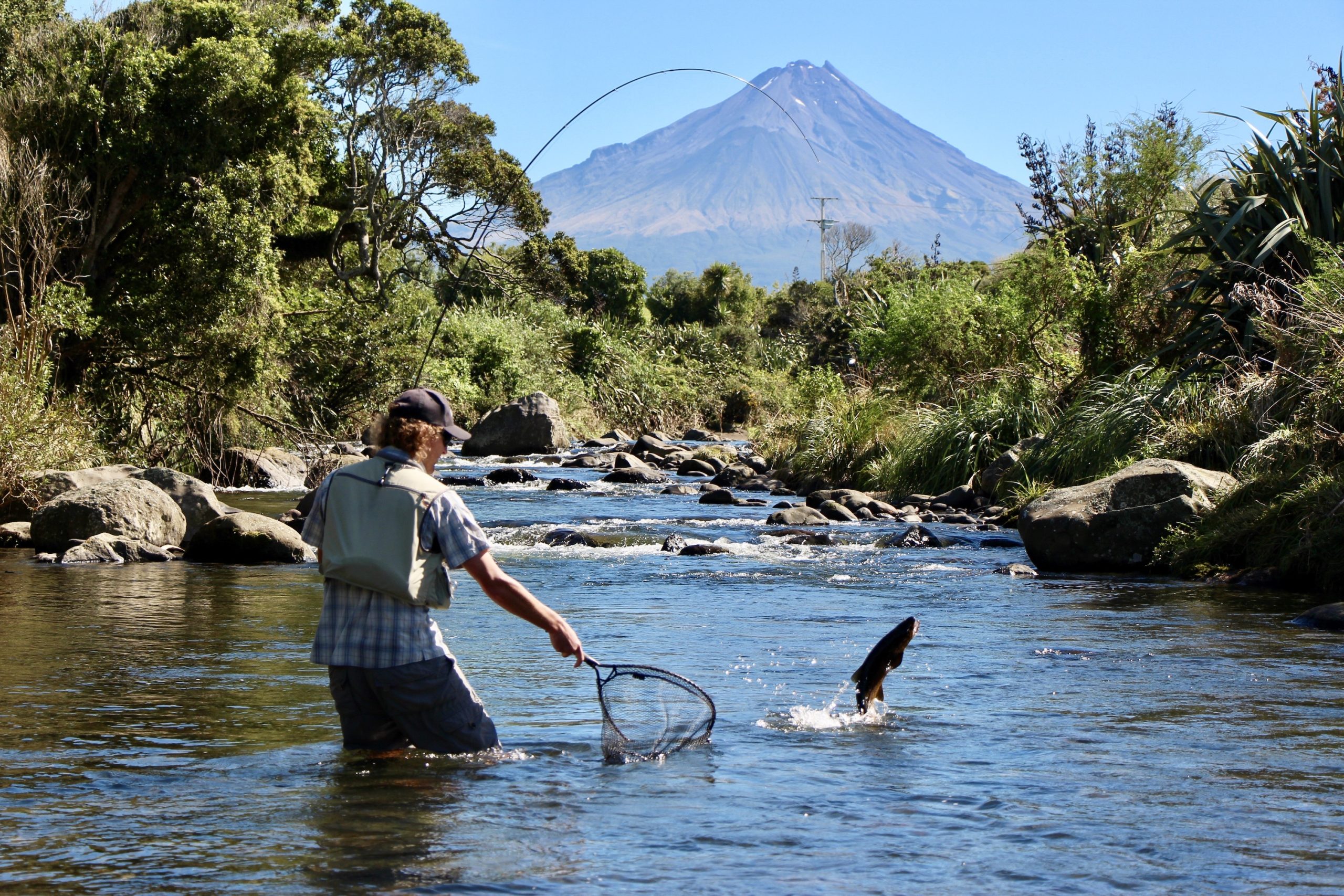 While my fishing passion is, and always will be, dry fly sight fishing for trout, some time ago, while still living in Australia, I became enchanted by two-handed casting. The feel and flow of the “waltz” of it is, to me at least, the equal of casting a single-handed rod. For a while my daily routine included a one-hour Spey casting session on the Queanbeyan River. With no real fishing application for a two hander near me, this was no bad thing. I could focus on the casting alone, with a blob of yarn as part of my fly anchor, with cruising carp and redfin being ignored. I think I became quite competent across a range of two-handed casts. This fed into my bamboo rod-making, where I have been very happy with three and four piece, solid and hollow rods between 10 and 12 feet.
After moving to New Zealand in 2021, I set aside my interest in two handers. Making rods, running rod-making classes, some dry fly fishing and guiding, and a four year battle with our local Council (recently won) took precedence.
But something clicked in the middle of this winter. The Rangitikei River, less than 15 minutes from home, has no closed season and is the perfect size for swinging flies. With a healthy population of both rainbows and browns, I would be crazy not to reconnect with some two-handed casting (and actual fishing)!
The Rangitikei is an iconic river (it even featured in the “Lord of the Rings” movies). The headwaters begin close to the origins of the Tongariro. While the Tongariro flows north-east, added to and dammed into Lake Taupo, the Rangitikei flows south directly to the ocean, unencumbered by dams. The Rangitikei is a large river, with about twice the average flow of the Tongiraro. The very upper reaches are “designated water” with a prolific population of large rainbows and browns. A local angler, who helicopters in there every year, said that last year’s five-day trip yielded over 100 fish between 4 and 9 pounds, and a few big ones that got away (of course). Below that, there is excellent non-designated water that can be reached from bridges, door knocking or rafting. VFFA readers will be familiar with recent articles from drifting with Stephen and company from Tarata Fishaway.
All of this water, as excellent as it is, is governed by the New Zealand trout fishing season. But… below the Mangaohane Bridge (basically downstream from Taihape), the river is open all year around. So this winter, I got off my bum and reconnected with my interest in two-handed casting (and this time around, some actual fishing).
Casting or Fishing?
With two bridges nearby, I had access to practice on both sides of the river, for all sorts of casts – Single and Double Spey, Snap T, Circle C, Snake Roll, and more. Early on I made the “mistake” of tying on an actual fly, rather than a blob of wool, during my casting. Almost incidentally, I started hooking into fish, both rainbows and browns. Catching fish slowed down my casting practice a little, but it has been a problem that I have been willing to deal with. I am sounding flippant, but seriously if you are focusing on casting, anchors, loops, lines, rod tapers, tips and leaders, the fish themselves can be a distraction.
The Rangitikei has proved the perfect balance for me in this regard. In a one-hour session, if I choose to work on casting alone I can cast across rapids for a re-cast in no time, thus maximizing my casting practice. Or, if I cast across some “middling” water, I can work on both casting and fishing with the chance of catching a fish. And if I really want to feel the tug of a fish, I can work some deep seams and pool edges, with more emphasis on “catching”.
The river height and colour is part of this equation. A raging brown river is fine (even better) for casting, but a lower flow and clearer water means a chance for more fish.
I can have a coffee in the morning at home, and decide by checking the webcam on the bridge at Mangaweka which way I will go…
(https://www.horizons.govt.nz/HRC/media/Data/WebCam/Mangaweka_latest_photo.jpg)
)
From a fishing point of view it is worth noting the nature of the Winter Rangitikei compared to the Tongariro. The Tongariro is loaded with fish in winter, with spawning fish running up from Lake Taupo. The Rangitikei does hold fish all through the year, but the locals tell me that many of the fish in the Rangitikei drop further down when it suits them, all the way to the estuary. It is whitebait season at the moment, so unless fish are actively spawning they are better off in lower gradient water full of easy food. I have been catching enough fish to have fun, but I do fully believe what they say. For me, if I really wanted to catch more and bigger fish from the Rangitikei, I would spend an extra hour in the car driving down the river. I am happy doing that I am doing – this is just a note for anyone visiting. Oh, and by the way, to date I have always had the whole stretch of river I have been on entirely to myself.
Tackle Talk
So far my go-to rod has been a hollow built, Bamboo, #4, 4-piece 10 foot Trout Spey, which works well with a range of lines between 290 and 360 grains (with a range of tips and leaders). I learned quickly that like purchasing a printer (where they virtually give you the printer and then empty your wallet on ink and toner), you can go down a rabbit hole with Spey and Switch lines, Skagit, Scandi and more…
Thankfully, my 10 foot Bamboo seems happy with a range of lines, but it is always fun to try another one.
More “Yes Minister” thinking from NZ Fish and Game
Having talked about the full-year open Rangitikei River, as I write this, on October 1 the New Zealand Trout Season is officially opening. In buying our 2025/26 Family Licence for the upcoming season yesterday, I received a rude shock. New Zealand Fish and Game have seemed to add another “Yes Minister” decision to their ever-growing list. VFFA members, and other Australians no doubt, will be no strangers to draconian “non-resident” licence changes over recent years. These include hard-core updates to “designated waters” (previously “back country”) permits.
It was quite a few years ago that while Miri and I were living in Australia, the “Family Licence” was removed for non-residents. As we always fished together on visits to New Zealand, and only for 5 – 10 days per year, scattered during visits to Miri’s family, this had been the perfect licence for us. On writing to NZ Fish and Game about the change, we were told that basically it was freeloaders like us that they wanted to hit hard. The result: we chose to fish elsewhere (Japan, the USA, Canada, and more in Australia). It felt really good to spend our licence money elsewhere. And to be honest, I like the fishing in all of those places more that New Zealand.
So fast forward several years – to 2021. We moved to New Zealand because of Miri’s ageing parents, not for the fishing. But hey, the fishing can be good, despite a lot of environmental decline, so we took advantage of that. As residents, the family licence was available. Miri only fishes occasionally, and often at short notice, and only with me, so the family licence was a good fit. We usually just share one rod, so effectively we are just one angler in terms of using the resource.
It has now been deemed that to qualify for a “Family” licence, we need to have a child or grandchild under 17 years of age. (A bit late for Miri and me at 57 years of age, with no children. I would love to go straight to grandchildren, but can’t figure out a way…).
I contrast this with the Tasmanian license structure which is scaled and sensible. ALL children under 18 are free, and season licenses are about half that of New Zealand (for both locals and non-residents). And there are 2 or 7 or 28 day or full season options available. Just common sense… (though the thing about “common sense” is that it doesn’t seem to be that common in NZ).
It seems to me that NZ Fish and Game are losing revenue, and are going to price themselves out of the market in a death spiral. I quote the NZ National Government’s Minister for Economic Growth, Nicola Willis, who said about foreign tourists that the goal was to “get as many dollars out of those back pockets as possible”. And now it seems that they want to do the same to residents as well …
By the way, I did write to Fish and Game NZ about their newest License change and received an insipid response about “hoping that we would still buy a full season license and get out in nature to appreciate all the benefits it provides”. Wow, what a revelation…
The license change was made supposedly on a study by the University of Otago, commissioned with our (Resident and non-Resident) license money by Fish and Game.
I have asked for both a copy of the study and the cost (from both F&G and the University), but have not yet received a response…
Thankfully, fish can’t read. Life is simple for them, except for the occasional hook…